

I Have No Inner Monologue
But I still think too much

A few years back (and against my better judgement), I attended one particular class in my 3rd year of University. It was a Dissertation Prep class conducted by the single most air-headed and sorry excuse for an academic I have ever had the displeasure of meeting.
I had long finished my dissertation by that point (two months early) and had no need for any advice or prep whatsoever - not least from a feminist/activist professor who’s only qualification for being in that role was her unwavering fealty to the fashionable Neo-Marxist Woke nonsense that has infested academia across the developed world.
I only attended because it was my middle lecture of three that day and was sandwiched between two important and entirely more useful ones - otherwise I would have swerved it entirely and gone home. I thought about getting a beer in the Uni bar to kill the time between the two real lectures, but felt too guilty at the idea of acting so dishonourably and disrespectfully.
So I sucked it up and went to the lecture - which was a terrible mistake. I was of course correct in my prediction that it would be a waste of 90 minutes of my life as my vapid, man-hating professor was on particularly idiotic form that day.
Worse, most of the entire 90 minutes were taken up by some inane New-Age ‘mindfulness’ pedagogical gimmick that my professor undoubtedly learned whilst scrolling Reddit or at one of the many Maoist teaching conferences I am certain she frequented.
Instead of teaching us anything or offering any tangible and practical advice on the subject of research/writing - she spent 90 mins essentially scrolling the internet while we students practiced 5 minute ‘visualisation’ exercises or ‘stream of consciousness’ writing. Those who regularly read my stuff on Substack will probably get where I am going with this but, for the uninitiated…
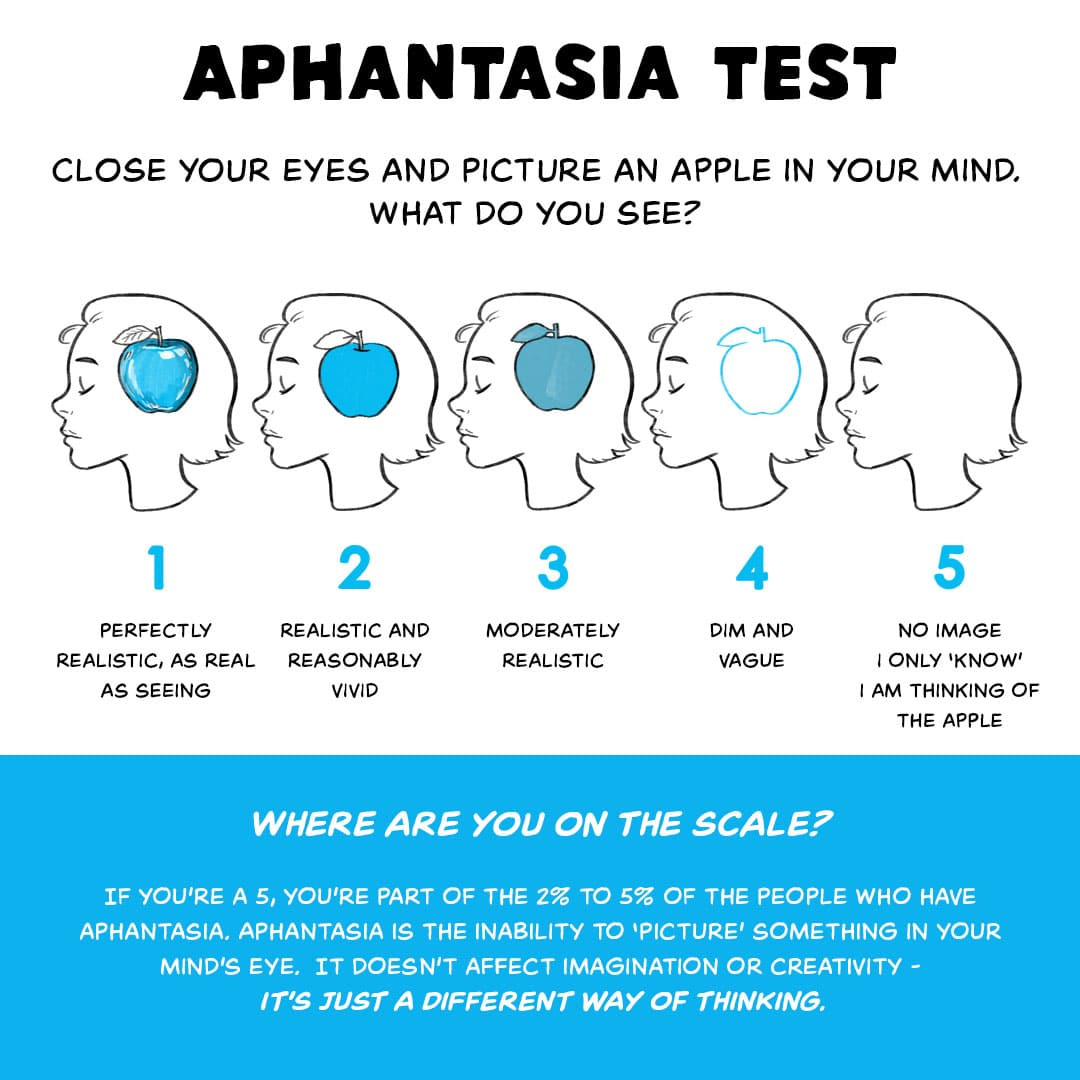
I have Aphantasia - a neurological condition that affects the part of the brain responsible for mental imagery (I am a 5 on the above scale) . I cannot generate voluntary mental imagery in my ‘Mind’s Eye’. No counting sheep. No picturing myself on a desert island. No imagining my audience in their underwear (do people actually do that? Perverted fucks). Nothing. Nada. My thoughts exist without any aspect that could be described as ‘seeing’ in any sense of the word. They are blank, black and imageless. I’ve written about it loads before and explained it in more depth in those articles, so I’ll say no more. If you want to learn more, read this.
So the ‘visualisation’ exercises our professor was assigning us in that class were absolutely pointless, useless and agonisingly insipid to me. I couldn’t do them if I tried (which I did, of course) and I had already finished my dissertation anyway. So I just sat there in a silent room while my fellow students imagined their ‘happy places’ or whatever-the-fuck they were hallucinating while our professor sat at her desk scrolling through posts on the r/allmenarepigs Reddit page or whatever.
I did get involved later in the class however as one of the exercises sparked an atom of interest in me, like a lone star in a night sky of boredom - a chance to finally use a neuron or two. In this final exercise, we students were instructed to ‘play our favourite songs’ in our heads as we wrote/typed.
Until then, all the visualisation exercises had been centered around ‘visual imagery’, something my entire class knew I couldn’t do - but this new one featured ‘auditory imagery’, which was the subject of my dissertation that I had spent the last few months researching.
I waited until the 5 minute exercise was over and asked extremely politely (one has to be careful around people who believe that ‘micro-aggressions’ are real things that matter and that all straight white men are Nazis) ‘Can I ask the class a question to satisfy a curiosity, please?’
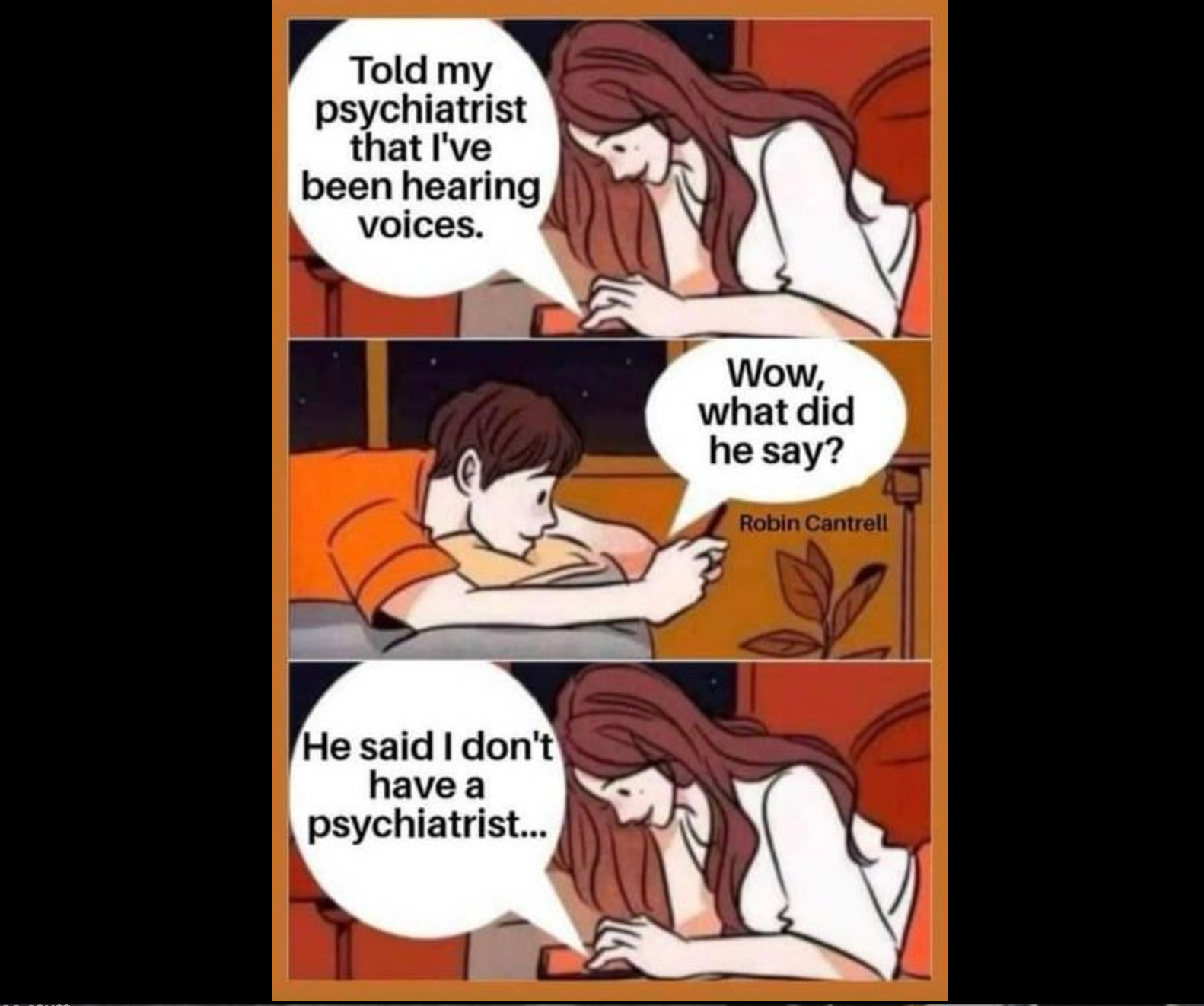
I then asked my classmates to describe the character of their individual qualias in the last 5 minutes - describe the phenomenon of what they perceived to be happening in their heads during the time. Did they hear music? Was it like the record? Was it as clear as it was if it was being played through a speaker? Etc. They all elaborated, I understood every word and I had absolutely no idea what a single one of them was describing. They all sounded crazy from my perspective, like a bunch of schizophrenics detailing their hallucinations and delusions to a psychiatrist in a mental asylum.
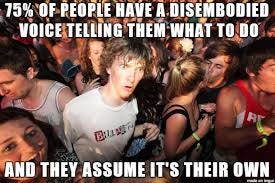
They were all amazed to hear that my Aphantasia prohibited the generation of mental imagery of a sonic representation as well as that of the visual kind. We were music students, so they were especially astonished to hear that I can’t hear music in my head (audiation). I told them that I knew it was odd, hence why I chose to write my dissertation about it.
One told me he composes his music completely in his head first, arranging instruments and dynamic changes as he formulates it et cetera - before finally putting it to paper or DAW when it is finished. He then asked me the same question as one of my other professors had months prior, ‘How do you write music when you can’t hear it in your head first?’ I answered him the same as I had in my previous encounter, ‘Music is a retrospective art for me, I don’t hear it until I play it. From there, I iterate on it and mould it after the fact’. This evidently broke his brain in several places at once.
Another lad told me he can’t turn the music off in his head, which he blamed for his chronic insomnia that he had suffered from since childhood (more on that presently.
Then, one of the girls in my class asked me, ‘You can hear your own thoughts though, right? An inner monologue? Music like that but just… music instead of words’. I then broke her brain too. ‘I don’t have an inner monologue. I don’t even know what you mean when you say it’.
Shocked, she then proceeded to tell me that she literally verbalised every single thing that ever happens as words to herself in her head. (literally = figuratively & verbalised = imagined). The things she sees and hears in the material world, her perceptions of them, her anxieties in response to them and her extrapolations about them based on past experiences, et cetera.
So I said, ‘So, it’s like JD in Scrubs? You literally narrate your entire life like a Film Noir?’. ‘EXACTLY!’, she exuberantly remarked.
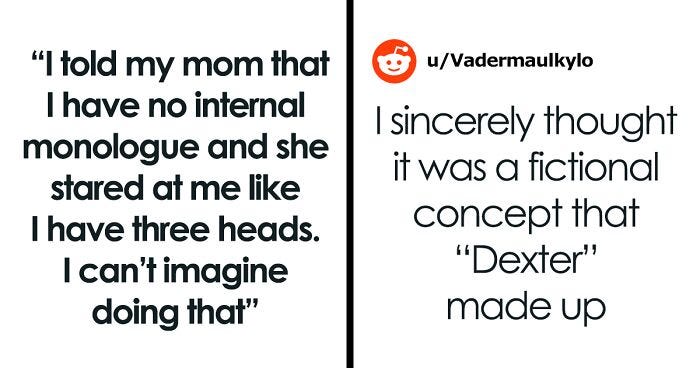
So many of my experiences when recounting my lack of mental imagery have played out like that. Disbelief, intrigue and most of all astonishment. It’s always a fun conversation.
But, with the lack of Internal Monologue thing more so than the lack of visual mental imagery, I read an exhaustive amount of inexplicably retarded things being said online. The one I read most recently (which inspired this essay) was particularly stupid.
I lost it in the doomscroll but it essentially said ‘When you hear that there are people without Inner Monologues walking around, it explains a lot of the retarded, NPC behaviour we see in the world. People just walk about without a single thought in their head. LOL LOL LOL. I’m a fat 30 something loser who lives in my mother’s basement, plays Fortnite all day and masturbates into lukewarm Hot Pockets’.
I paraphrased the above quote just a smidge.
I see this a lot - the conflation of internal dialogue and the act of thinking into one phenomenon. They think the two are one and the same because their own experience of their own mental state (qualia) is like that, so they can’t make a distinction between the two. To them, thinking manifests itself as an inner voice and they assume that that’s just what thinking is.
When people adopt this framework, they will necessarily assume that anyone who doesn’t have an inner monologue is not thinking or having a conscious experience at all. But, if a person is alive, capable and consciously interacting with the material world, this is naturally impossible. They must be thinking, else they wouldn’t be capable of doing almost anything wilfully.
This fact leads a lot of people to assume that people are either lying or under a misapprehension when they say they have no inner monologue, because they are incapable of understanding that some people’s qualia experience differs in any way to theirs. They assume that it is a categorisation error on the person’s part - mischaracterising their imagined thoughts as being silent.
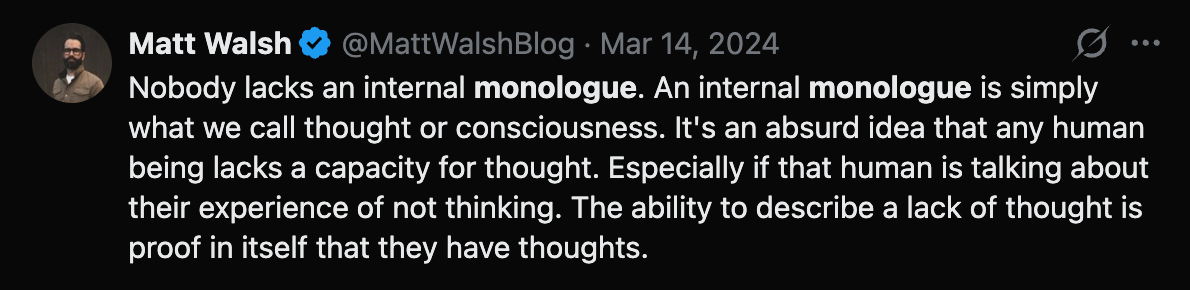
And it’s not just gastropods like Matt Walsh who think this - I’ve seen dozens of posts on various platforms from actual human beings who believe the same nonsense as this twat.
They are all wrong, of course. First, let me address the claim that we who have no internal monologues are unthinking NPCs walking around without any discernible brain activity happening.
I am an overthinker. I think ALL THE TIME. I can’t turn my fucking brain off… ever.
I obsess over films I’ve seen, books I’ve read, music I’ve listened to, the news, everything. So much so I struggle sleeping. Like my Uni classmate, I have had issues with insomnia throughout my life and I often lie awake until 4am thinking about some trivial little issue. It’s half the reason I started writing blog posts on Substack - the finality of writing my thoughts down and hitting publish gives me a sense of closure that can alleviate my obsession long enough to fall asleep.
I worry about the future constantly (the definition of anxiety) and have done since I was a child. I still have the terrible habit of biting my nails when I do, something else that has persisted since childhood.
I torture myself by replaying embarrassing memories from my past incessantly, reliving the cringe and wondering if I should move to some place new where nobody knows me and I can pretend that it never happened. (I know that probably no-one else in those memories even remembers the incident, but I do).
I worry about money, imagining what my life would be like if I won the lottery. What I’d buy, where I’d live and who I would hire a hitman to whack.
I write song lyrics, essay drafts and imagine myself giving a perfect performance at my next live gig.
I think about sex once or twice roughly every femtosecond.
When I am hungry, all I can think about is food (inbetween the moments when I am thinking about bumping uglies) until I eat something.
When I crave nicotine, I imagine smoking a cigar or remember sharing a cigarette with an ex-girlfriend in the pissing rain outside a pub - the pair of us trying to shelter away under the pub’s 5 inch awning.
And (confession time) I spend an inordinate amount of time recalling Ginger Cook (GC) short story Crow Party to mind.
That is my qualia, my conscious experience, 24/7. A never-ending barrage of thoughts, musings and deliberations (and perversion, it must be said). But during none of it do I see or hear anything in my mind. My thoughts are there and I am acutely conscious of their existence - but they never appear as a representation of sound or sight at all.
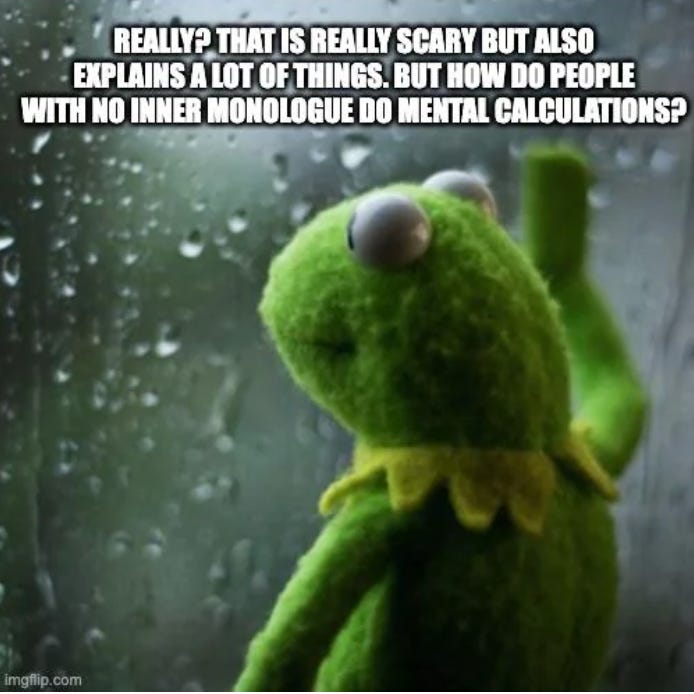
That means, thinking and inner monologue are not one and the same - rather, they are two distinct things. One is the neurological processing of information, a base human function, and the other is just the manner of character that that function manifests itself in certain individuals. I say certain because one study I read suggests that only a minority of people (between 30% and 50%) possess an actual inner monologue and that the norm is not so. You people who are talking to yourselves all day in your head are the freaks, not me! 🤣🤣😂

When researching this article, I came across a post (above) on Substack from a writer whose book I have actually read, Austin Kleon. There were some interesting observations in it that I wanted to address. First, Kleon said his wife Meg has Aphantasia (visual only) and seems to suggest that this is why she has such an over-active inner monologue.
Based on my dissertation research however, I think this is an error. Many Aphants have an inner monologue true, but many more are like me where their Aphantasia is Multi-Sensory, affecting their sonic mental imagery as well. And the frequency of inner monologues occurring in aphantasia patients is slightly less common as it is in the general population. If it was happening in response to the condition, one would expect it to occur more frequently, not less. There is no evidence that lacking one imagined sense strengthens another (like Daredevil?).
Secondly, Kleon makes the same mistake I addressed earlier when he conflates thinking with mental verbalisation, which in turn would suggest that they are the exact same phenomenon.
‘This is why it’s terribly frustrating for Meg when she has three boys in her house talking to her at once — she literally can’t hear her own thoughts’.
Again, my past research and experience leads me to believe that this is a misapprehension on Meg’s part. I think she has conflated the fact that her thoughts are expressed so overtly as ‘heard’ words in her head with needing to hear those words to think clearly.
I cannot ‘hear’ anything in my mind, words included, and I still find it difficult to collect my thoughts and think concisely when there is a lot of noise around. (I’m one of those insufferable people who turns the car radio down when I approach a junction because I can’t focus on the road if there is too much noise in the car). I don’t need to hear my thoughts to think, but I do need quiet to focus.
I even use the term ‘I can’t hear myself think’ when voicing my irritation in these scenarios because that is the socially accepted idiom that people use to describe such an emotional state. But it’s not actually because I can’t ‘hear’ an internal monologue that leaves me flustered, more that I am unavoidably distracted from focussing on the task at hand.
I know this because the exact same thing happens when I am desperate for a pee, which has nothing to do with mental imagery at all - I can’t focus on anything or perform even the most rudimentary of tasks until I have alleviated myself of the thing that has so captured my sole attention.
So, there you have it. Some know-it-all incel on Twitter wrote some retarded shit about people without inner monologues being unthinking, NPC zombies and it pissed me off so much that I couldn’t rest until I had sat down and put him in his place with a 2500+ word essay. He’ll never read it of course but that doesn’t matter. This essay is the proof, you see. I have been obsessing over that Tweet for a couple of days now. I couldn’t get it out of my mind - I couldn’t stop thinking about it.
And I never heard anything - not a single word of internal dialogue, but I was thinking about it constantly. Mulling it over and formulating my thoughts into an argument until I had them concisely organised enough to type this essay. I’ve have written hundreds of essays equalling many tens of thousands of words, and I have not once talked to myself in my head like a fucking madman. Who needs an inner monologue, eh?
Thanks for reading - The Common Centrist
I remember you writing about this before. Still absolutely floors me.
Such an interesting topic to read about and learn about
Also, thanks for that surprising shout out 🥳🥳
"I torture myself by replaying embarrassing memories from my past incessantly"
I struggle to understand how one can 'replay' a memory if they can't get video (imagery) in their head. :)
You probably meant something else here, but I can't quite grasp it. I'm probably about a 3 on that scale, where I can still get mental visuals, but they're fuzzy (or even get some details wrong), especially after 30 or 40 years.
I don't narrate my entire life but I will mentally think things to myself, about myself. Although I grew up fairly alone so I tend to do it out loud as well, whenever I'm alone, such as driving. I can think silently, but doing it out loud is comforting and helps me focus, if that makes any sense.